 India collaboration ↗
Chatake Innoworks Private Limited proposes a software-led bioenergy service that helps operators understand production records and test decisions before applying them. The first implementation will use an existing small farm biogas installation, subject to safety and access review. A larger municipal plant is a future pilot opportunity, not a construction prerequisite or confirmed partner.
GFIS’s broader purpose is to make organic-waste-to-energy services more accountable. A plant manager should be able to distinguish recorded gas flow from estimated methane, a measured event from a simulation, and a forecast that beats a simple baseline from one that does not. This distinction matters when public money supports waste processing and local energy recovery.
Production estimates are difficult to verify when feed records, process observations and gas measurements use inconsistent units or dates. Machine learning can magnify this problem if it produces an apparently precise answer from poor input data. An operator needs a usable record and an explanation of uncertainty before an optimisation recommendation.
The initial farm assessment will establish which of these problems actually occur locally. We have not surveyed a municipal service or quantified affected households. The submission therefore proposes a measured first demonstration and a subsequent partner-backed integration, rather than presenting a national deployment as complete.
GFIS has public engineering interfaces, model comparisons, historical reactor/SCADA replay, numerical simulation and digital-twin visuals. Separate India-facing pages explain collaboration and planning. Synthesis provides authenticated application workflows, while research materials remain protected. These are existing software components. This proposal does not claim that the farm is connected to them today.
The retained DS-06 experiment artifacts report 500,400 raw one-minute DS-06 records and 491,761 processed records from a full-scale facility. The target is total biogas flow in CFM. Three rolling-origin folds and repeated seeds support a mean LSTM MAE of 13.9378 CFM compared with persistence at 16.7470 CFM. These historical findings do not establish multi-plant performance. The separately retained methane task has only 86 eligible observations and favours persistence on rolling validation. The first farm study must not inherit the industrial model’s accuracy claim.
A retained 48-hour simulator run supports scenario inspection. Its horizon is simulated time. It does not establish two days of physical testing, continuous training or autonomous control. Planning maps and city-network models are illustrative scenarios. Gasification remains a separate thermochemical prototype and is outside the first anaerobic-digestion pilot.
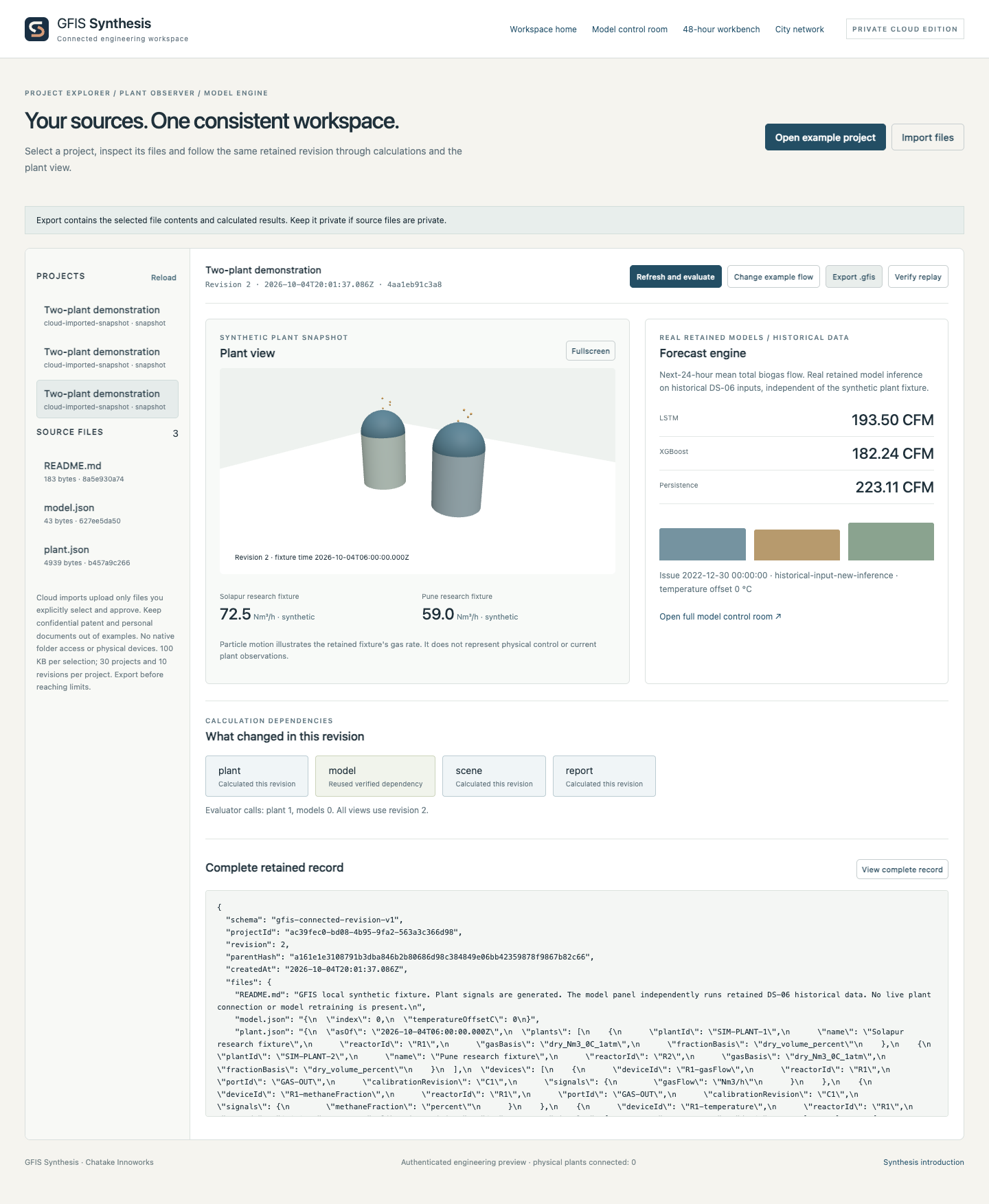
GFIS Synthesis is the software workspace supporting this proposal. The deployed web edition connects explicitly consented file snapshots with a project explorer, plant view, retained model inference and checked experiment revisions. Its project data requires authorised sign-in.
The operator can inspect source inputs and calculation dependencies, save a checked revision, export its record and verify a same-engine replay. These functions provide a traceable workflow rather than an unexplained prediction. The web edition imports bounded snapshots; it does not automatically watch a computer folder or synchronise with the separate desktop application.
Retained LSTM, XGBoost and persistence models operate on historical DS-06 total-biogas inputs. The synthetic plant example and its composition arithmetic are distinct from that inference. Neither constitutes continuous methane validation, a laboratory-validated VFA/ALK soft sensor, retraining or live farm telemetry.
For the proposed pilot, the intended workflow is farm observations → data-quality review → Synthesis analysis and scenarios → operator review → saved experiment/report. Safe measurements, an agreed record schema and prospective evaluation must precede any claim about local forecasting performance. The existing software does not remove those field-validation requirements.
Open the public introduction · Connected workspace: authorised sign-in required.
The owner reports an existing basic farm biogas installation costing approximately ₹10,000. The photograph shown on this website provides physical context for the proposed pilot. Purchase price, capacity, present output and condition are not verified from the photograph.
Begin with a competent condition and installation review. If there is no safe, compatible gas-flow measurement option, continue with manual feed/temperature/use records and software replay demonstrations, and postpone gas-forecast validation. Do not pierce the gas holder, improvise electrical equipment near gas, add compression or bypass existing safeguards. Instrument work belongs to a qualified installer.
| Period after site approval | Work and deliverable |
|---|---|
| Days 1–7 | Condition/access review, data dictionary, record sheet, instrument quote |
| Days 8–21 | Manual baseline and usability walkthrough; no plant intervention |
| Days 22–60 | Continue records; install approved measurement only if safe and funded |
| Days 61–90 | Quality review, feasible baseline comparison, operator report and go/no-go decision |
| Months 4–6 | Seek an institutional or municipal host and agree a separate data protocol |
| Months 7–12 | Replicate only after site-specific validation and funded integration |
This programme is relative to permission and resources. It is not a claim that a 90-day field study will be complete before the competition deadline.
Proposed usability target: the operator completes a daily record and produces a dated report without developer help after training. Record actual time and failed tasks. Proposed record-quality target: at least 90% completion of agreed daily fields over the observation period, with all absent values marked. These are future acceptance targets, not measured achievements.
Gas-forecast evaluation requires a calibrated gas target and sufficient chronological observations for train/validation/test periods. A short daily record cannot establish an industrial LSTM result. Start with persistence; assess MAE and RMSE in the measured target’s units. Report missingness, uncertainty, error on feed/temperature regimes and negative results. Keep any final evaluation period untouched during tuning. If there are too few valid observations, report feasibility and measurement quality rather than a model-success claim.
Energy accounting requires gas volume at defined reference conditions and contemporaneous methane fraction. We cannot convert a total-biogas value into methane by naming it differently. A future VFA/ALK study would need paired laboratory measurements and a separate validation design. The farm programme does not yet provide that evidence.
All rates below are planning allowances, not supplier quotations. INR. Existing plant and founder software-development time are excluded. This is incremental cash expenditure rather than fully loaded project cost. GST treatment, support eligibility and the funding ask need approval.
| Item | Quantity | Assumed rate | Amount |
|---|---|---|---|
| Basic feed weighing and manual record tools | 1 set | 2,000 | 2,000 |
| Temperature logging equipment, suitable placement pending | 1 set | 3,000 | 3,000 |
| Compatible gas meter allowance, subject to engineering review | 1 | 8,000 | 8,000 |
| Qualified installation and safety review allowance | 1 | 5,000 | 5,000 |
| Calibration or periodic sample service allowance | 1 lot | 5,000 | 5,000 |
| Field travel and operator instruction | 1 lot | 4,000 | 4,000 |
| Incremental data hosting/export allowance | 1 lot | 2,000 | 2,000 |
| Subtotal | 29,000 | ||
| Contingency, 10% of subtotal | 2,900 | ||
| Provisional incremental total | 31,900 |
If a safe calibrated measurement setup exceeds these allowances, revise scope and budget before procurement. A self-funded manual-record demonstration may proceed without a gas meter, but cannot validate gas-flow prediction. No advanced methane analyser, new digester, upgrading/compression plant, pipeline, land or civil works are included.
Report feed actually accepted and processed in kg/day, not total municipal waste generated. Keep contamination/reject mass separate. Gas production is an observed variable only after appropriate measurement.
For a later energy calculation, define:
Then methane volume is V_CH4 = V_b × x_CH4, and usable energy is E_use = V_b × x_CH4 × LHV_CH4 × eta. Annual net benefit equals verified displaced-energy value plus other separately evidenced revenues, minus operating and service costs. Do not count the same gas as both sold fuel and generated electricity. Missing composition/reference conditions mean the energy result is unavailable.
No numerical energy gain, payback, emissions reduction or household count is claimed here. Carbon accounting requires a defined counterfactual, leakage measurement/estimate and an accepted method. Those are separate evaluation inputs.
An initial paid integration could include data mapping, operator training and a defined evaluation report. A subsequent software/support subscription could cover retained records, forecasting updates and scenario exports. Pricing must include delivery effort and maintenance; it is not set in this proposal. Public-service value should be assessed independently of sales.
Expansion requires each site’s data rights, instrumentation, operating envelope and operator acceptance. Shared software does not eliminate plant-specific calibration. A district portfolio is useful only when individual plant records are reliable. City pipelines, gas balancing and 30-year investment plans remain scenario tools until engineering, demand, permissions and cost inputs are established.
We seek measurement-design mentorship, independent engineering review and access to a future consenting institutional/municipal partner. Financial support, if requested, will follow verified quotations and an approved scope. Applicant-company documents and domicile evidence will be handled through the official portal, not public demo folders.
The pilot requires site permission and agreed data rights before work begins. This proposal does not assert a granted patent. Private research remains access-controlled.
The pilot is read-only. It will not issue actuator commands, modify protection settings or replace operator judgement. Plant staff own safety decisions. A stopped data connection should produce an explicit unavailable state, preserve the last record and never imply that the plant itself stopped or remained stable.
This public proposal is not confirmation of competition selection, funding, field validation or official endorsement.