 India collaboration ↗
GFIS combines historical data analysis, software replay and numerical scenarios. These are different forms of evidence. None establishes a connected farm trial or autonomous physical plant control.
The Muscatine WRRF anaerobic co-digestion dataset is hosted by Iowa Research Online, DOI 10.25820/data.006715. GFIS identifies this source as DS-06. The retained raw SCADA source contains 500,400 one-minute records; the processed set contains 491,761 records. The target is total biogas flow in cubic feet per minute (CFM), not continuous methane production. Dense records from one facility are not independent plant replications.
The retained experiment DS06-Q1-20260827T155346Z uses chronological evaluation. Model selection uses rolling-origin mean absolute error after averaging repeated seeds within each fold. Preprocessing is fitted on training observations; the final test period is not used for tuning.
| Model | Rolling-origin MAE, mean ± fold standard deviation (CFM) |
|---|---|
| Persistence | 16.7470 ± 5.2402 |
| XGBoost | 16.7663 ± 6.3366 |
| LSTM | 13.9378 ± 4.3120 |
Lower MAE is better. These are retained results, not a new training run performed for this competition. They support a task-specific temporal-learning result. They do not establish accuracy at the founder’s farm, cross-plant transfer, methane-composition estimation or industrial control readiness. The final-period challenger and the complete experimental interpretation remain in the protected research archive; rolling performance alone is not a universal model ranking.
The public summary was checked against the retained verified-primary rolling-summary CSV and run manifest on 14 October 2026. No underlying observations, model weights or private manuscript are redistributed here.
The separate DS-05 study uses Mendeley Data, DOI 10.17632/jpnjmzp6bj.1. The GFIS methane task has 86 eligible observations and favours persistence in its retained rolling evaluation. It must not be merged with the dense total-biogas task as if they shared a target, units or sampling regime.
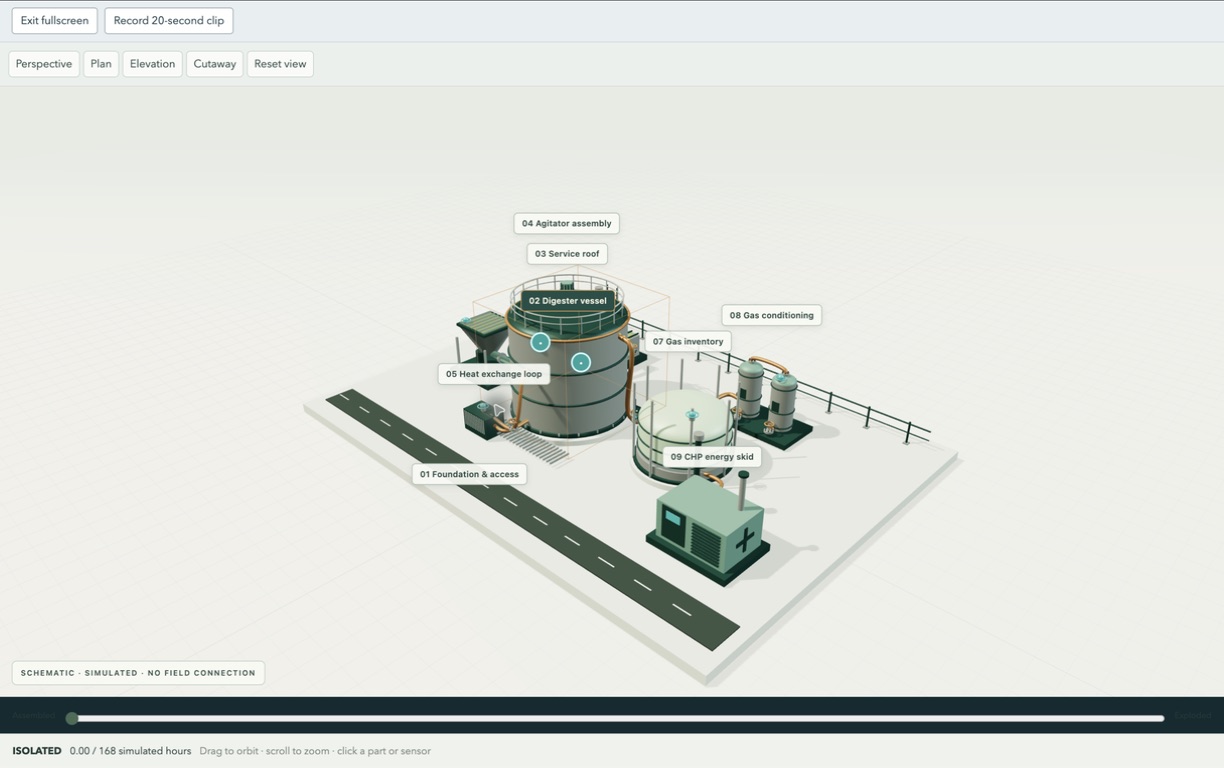
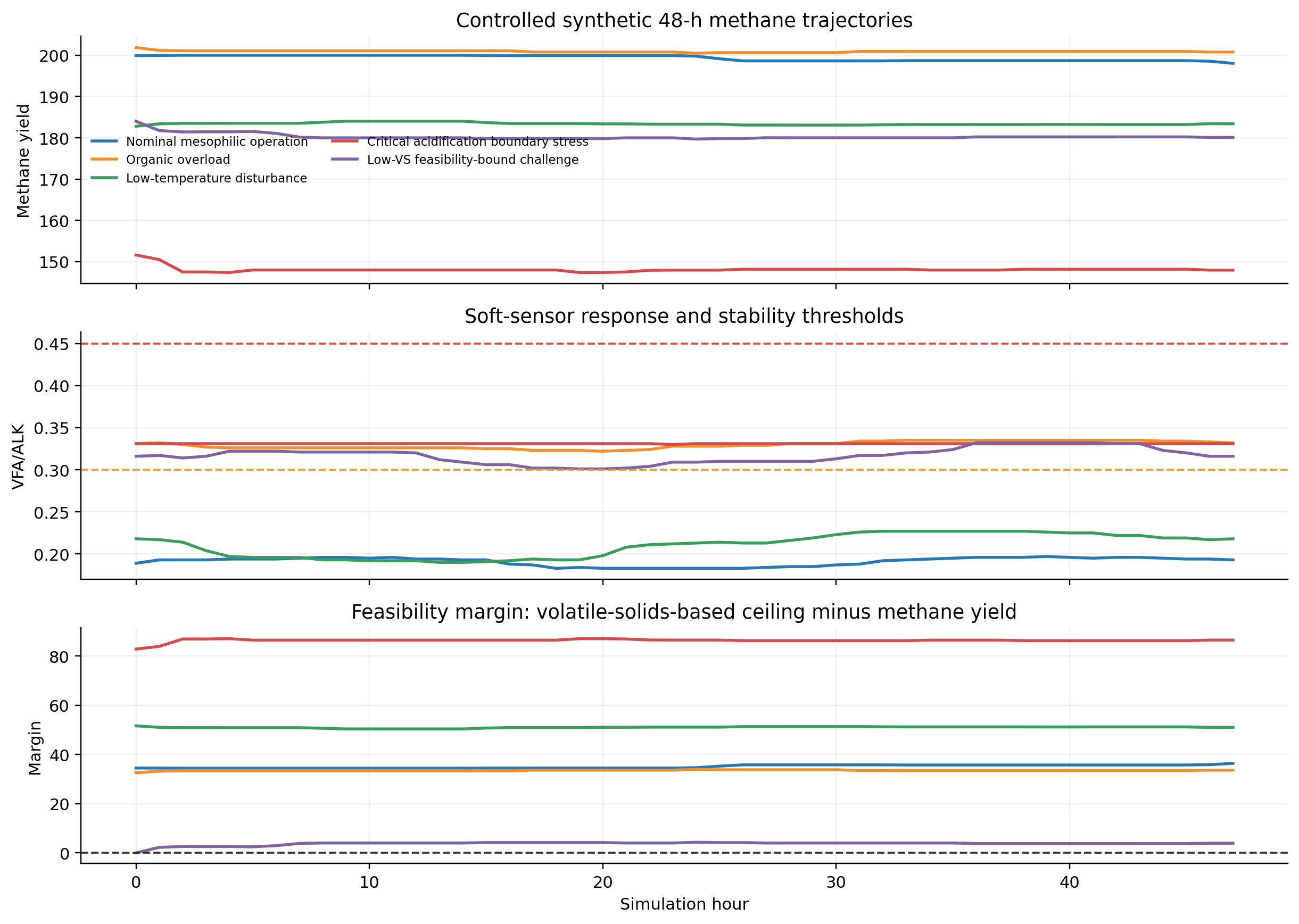
The plant assembly image is an existing GFIS schematic software interface. The 48-hour chart represents numerical trajectories under chosen scenario assumptions, not two days of observed farm performance or continuous model training. VFA/ALK outputs are model responses awaiting laboratory validation. Gasification is a separate thermochemical prototype and is outside this first anaerobic-digestion field programme.
The retained 2 and 5 October releases document the public Synthesis introduction and the authenticated Connected Workspace. The workflow includes consented bounded snapshots, checked revisions, project exploration, synthetic plant views, historical DS-06 model inference, export and same-engine replay. The web and desktop editions are separate; a browser import is not native folder attachment or automatic synchronisation.
The figure on this page is an actual retained local verification capture. It shows a synthetic two-plant fixture beside a separate historical model panel. It is not evidence of a physical connection, prospective farm performance or a fresh authenticated production acceptance test. The 5 October record documents adapter tests and controlled cloud checks; owner-authenticated acceptance remains a separate step.
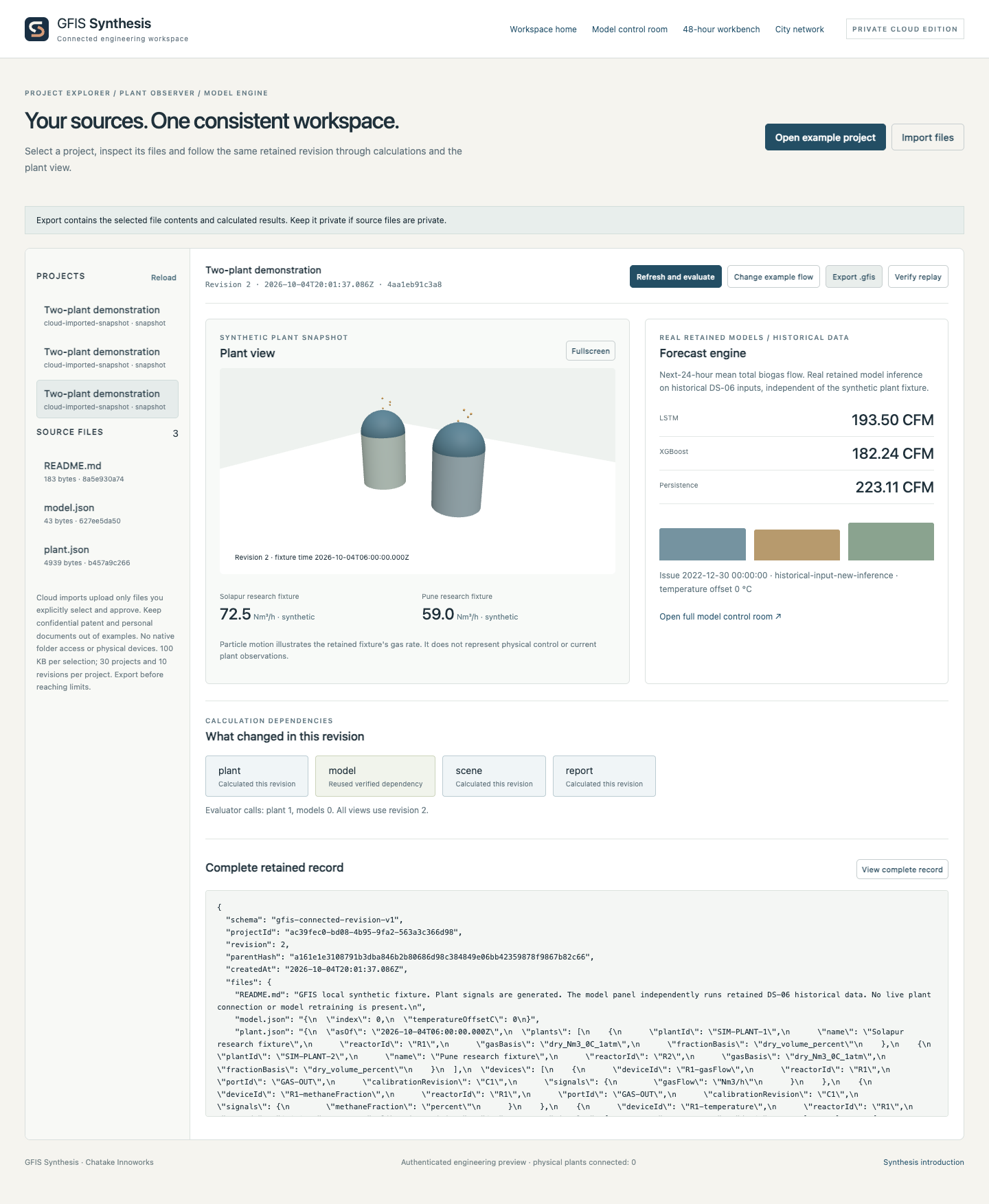
Synthesis introduction · Connected workspace (authorised sign-in).
The owner-provided farm photograph establishes the physical context of a small installation. Its condition, capacity, current production and measurement compatibility still require assessment. The pilot protocol begins with safety review and manual records. Gas forecasting requires a measured, sufficiently long target series. Missing measurements will remain missing, not be replaced by simulated ground truth.
A service-unavailable message is not a plant-state measurement. Retained screenshots are documentary illustrations rather than proof of current backend operation.
The business proposal describes a read-only, farm-first programme and a provisional incremental budget. National maps and city-network views are planning scenarios, not commissioned pipelines. Selection, funding, partner participation and environmental benefits have not been established by this website.